Hello again, and welcome back. It’s been a while since I last wrote here, and I’m excited to bring this blog back to life as a home for stories from my classroom. I want to document the everyday moments of play and learning that happen with my three- and four-year-olds, and share them as they unfolded. At the end of each story, I’ll share how I captured it, because good documentation is what lets these small moments become stories worth telling. Thank you for still being here.
A note on privacy: all children’s names in this story have been changed to the names of my family pets to protect the privacy of the students.
The learning story
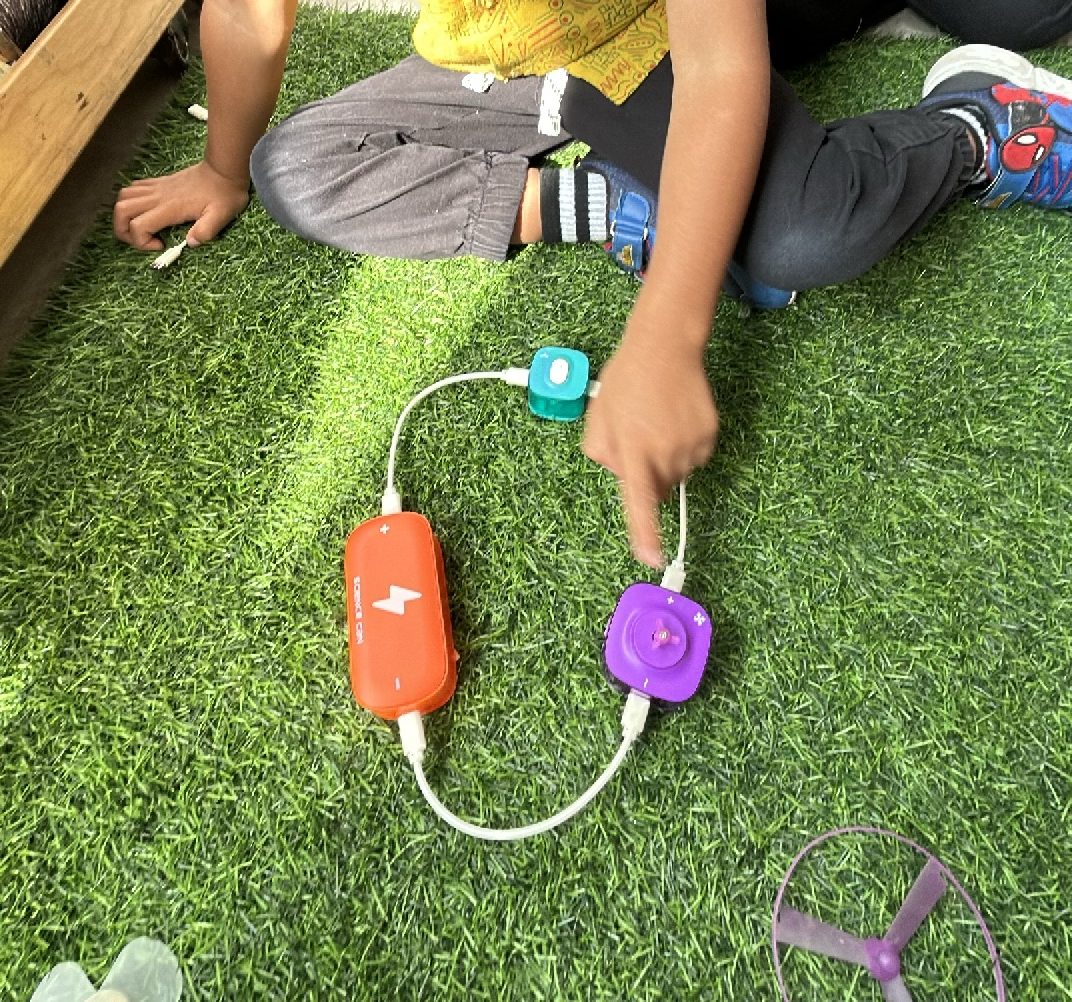
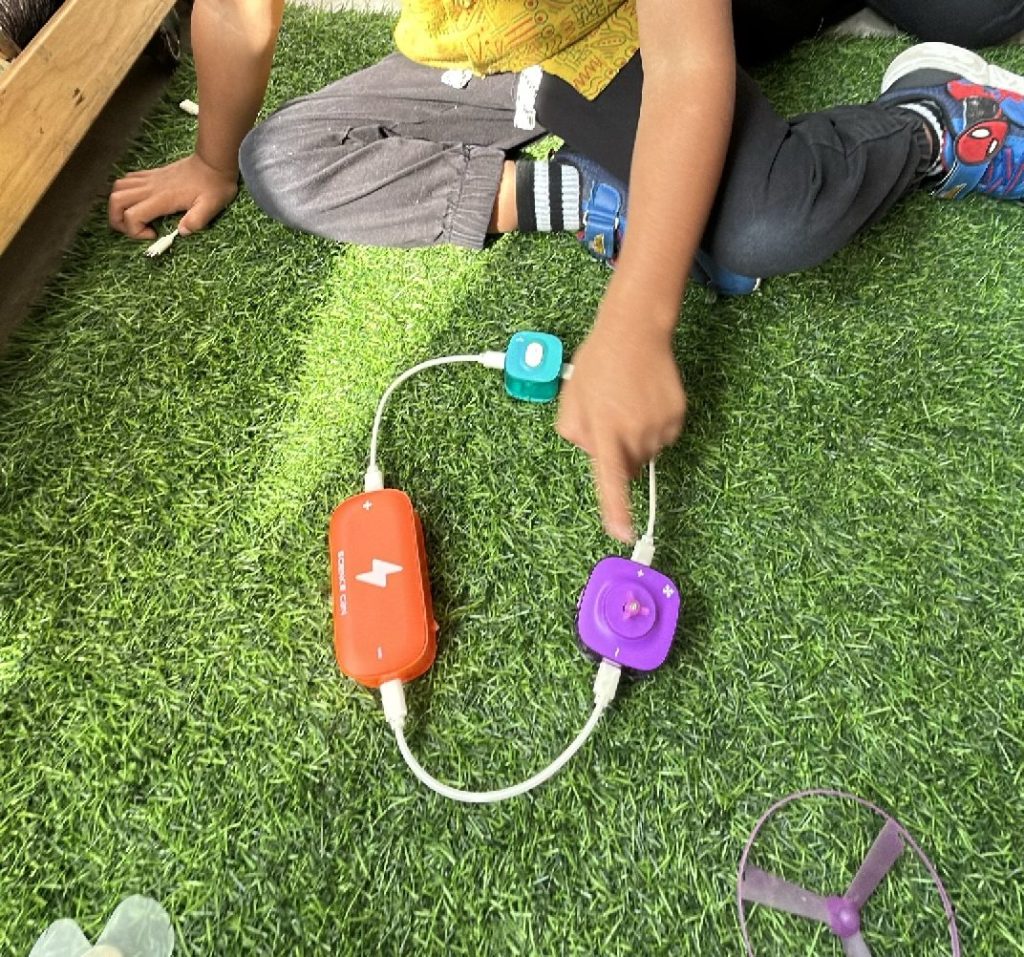
Mac found the circuit pieces spread before him and instantly noticed they were disconnected. Knowing that the components needed to form a complete loop, he set to work right away. He connected the power bank, dial, and propeller motor, then turned the switch, but the motor did not start. Mac pulled all the connectors out and started again. This time, the motor whirred to life immediately.
With the dial linked directly to the motor and battery, Mac could control the motor’s speed. Yet a new puzzle emerged. Yesterday, turning the dial up high made the propeller spin, lift off, and float into the air. Today, it didn’t do this; it either stayed connected or tipped off its base. We both struggled to understand why.
To test our thinking, I retrieved a different connector, a simple on/off switch. I showed it to Mac and asked, “What would happen if you swapped this out for the dial switch?” Without hesitation, he identified where it belonged and made the exchange. These switches work regardless of orientation, and Mac really liked the instant feedback of the on/off control. However, the stubborn propeller still refused to fly.
Seeking another approach, we went back to the component box together and pulled out a fan piece with soft blades that are safe for children to touch. Mac initially struggled to attach it to the motor, so I turned it upside down and showed him how, unlike the propeller, which just slips on, this fan actually slots into place. Once he connected it securely, he switched it on and thoroughly enjoyed putting his finger in the spinning fan to feel the safe, soft breeze.
How I documented this learning
The richest evidence in this story lives in the in-between moments: the silent motor on the first attempt, Mac deciding to pull every connector out and start again, the swap from dial to switch, and the moment the soft fan finally slotted into place. Each of those moments shows his thinking about how a circuit works, and each one passes quickly.
I gathered the evidence in two ways. I took photographs at each stage of the investigation, from his first loop through to his finger in the fan’s breeze. I like to take a lot of photos so that I always have options. I don’t use them all, but taking plenty means I can always find the one that best brings the observation to life. I also recorded Mac explaining his thinking as he worked, so his own words about why the motor needed a complete loop, and what he expected the switch to do, were captured as he said them.
I use Sorone to keep it all together. Sorone is a photo organisation app for early years teachers, and it held the photographs and the recording of his thinking side by side in one place. When I sat down later to write this learning story, the whole sequence was waiting for me: what Mac did, shown in the photographs, and how he reasoned about it, in his own voice. That pairing is what turned a busy few minutes at the circuit table into a story I could tell accurately.
A note on privacy: all children’s names in this story have been changed to the names of my family pets to protect the privacy of the students.


